
There is a particular kind of chaos that arrives with a child’s first birthday.
One moment they are a baby, held, carried, and observed. The next, they are upright. Moving. Opinionated. Reaching for things they cannot have, pointing at things they want you to see, handing you a toy with the expectation that you will understand exactly what they mean by it. The shift from baby to toddler happens at the intersection of movement, language, and will, and the second year of life is where all three arrive at once.
The milestones of the first year were largely about the body learning to function: holding a head steady, sitting without support, grasping a rattle. The second year is different. This is the year of doing, of communicating, of pretending, and of becoming a social being in the fullest sense. Language moves from single words to phrases. Play becomes imaginative. Running replaces walking. And somewhere in the middle of it all, a personality, unmistakable and entirely their own, takes clear shape.
As with the first year, developmental milestones are guides rather than fixed deadlines. Every child develops at their own pace, and it is common for some milestones to appear earlier or later than expected. In many cases, a variation of 3 to 6 months can still fall within the range of typical development. What matters most is that your child continues to make steady progress across movement, communication, play, and social interaction over time.
13 to 15 Months: Walking, Words, and the First Tower

The first birthday often brings with it the first independent steps, but walking is rarely a neat milestone with a clean arrival date. Many children who took their first steps close to 12 months are now walking with more confidence and speed. Others are just getting started. Somewhere in this window, walking becomes the primary way a child gets from one place to another, and supervision becomes considerably harder because they are fast and determined.
At the same time, something interesting is happening with their hands. By around 12 months, a child can turn the pages of a book, a seemingly small act that reflects a meaningful shift in fine motor precision. They are not grabbing pages in fistfuls anymore. They are beginning to handle objects with intention and increasing control.
Around 13 months, scribbling begins. Offer a crayon and they will make marks on a page, not pictures or letters, but the first visual traces of purposeful hand-to-eye coordination. The scribble is the precursor to everything written and drawn that will follow.
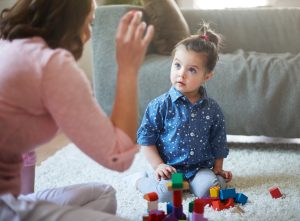
By 15 months, many toddlers can build a tower of two cubes, stacking one block deliberately on top of another and watching with satisfaction when it stands. This is not just a fine motor task. It is a moment of genuine problem-solving: the block must be placed, not thrown or dropped. The goal is the tower. The child knows this, and tries.
Language, too, is arriving in earnest. Around 12 months, most children say their first real word beyond “mama” and “dada”, using it consistently and deliberately to refer to a specific person, object, or event. By 15 months, many children have four to six words in regular use, the beginning of the process of labeling the world.
16 to 18 Months: Running, More Words, and the Problem of Getting Things Done
Running arrives around 16 months. It is not elegant running. Instead, it is a wide-legged, slightly top-heavy gait with arms working hard for balance. But it is running. The toddler is no longer just walking; they are propelling themselves, testing speed, discovering that they can outpace their own balance. Falls are frequent. They get up and go again.
This increase in mobility changes everything about a child’s relationship with their environment. They are covering more ground, reaching higher things, getting into more spaces. Independence is no longer just a developmental concept. It is a daily physical reality.
Language continues to expand steadily. By 18 months, most toddlers speak around ten to fifteen words, and they are beginning to name the things and people around them with growing precision. Object names, people’s names, and the names of beloved animals and foods all become part of a vocabulary that accumulates word by word, with each new word arriving with visible delight.
Something subtle but significant also emerges in this window: the use of tools to extend reach. A child who cannot quite grasp something just beyond their fingertips may reach for a stick, or a spoon, or any nearby object, and use it to close the gap. This is not accidental. It shows a mind beginning to think in sequences: “If I cannot do X directly, I can use Y to help me get there.” This represents an early form of purposeful problem-solving.
Pretend play is also deepening. A toddler who at 12 months might have briefly touched a toy cup to their lips now engages in more sustained symbolic gestures, such as giving a doll a sip, feeding a stuffed animal, or holding a toy telephone to their ear. The doll is not the doll. It is, in the toddler’s mind, something the doll represents. This is the beginning of symbolic thought, and it is one of the most cognitively remarkable things happening in this year.
19 to 21 Months: First Sentences and Stacking Higher
Somewhere around 19 months, two-word sentences begin to appear.
“Mommy shoe.” “More milk.” “Daddy go.” The grammar is absent, but the intent is clear. The child is learning to combine words to communicate something more complex than any single word can carry, and the fact that they are doing this means something important about the architecture of their developing mind. Many children begin combining two words once their vocabulary approaches about fifty words, although there is considerable variation.
This is one of the most significant language milestones of the entire second year. Once sentences begin, language typically accelerates rather than slowing down.
By this age, fine motor skills have also matured considerably. A child who built a tower of two blocks at 15 months can now stack a tower of six cubes at around 22 months. This requires steadiness, precision, and the ability to moderate force. Too much pressure topples the tower, while too little means the block will not stay in place. Watching a toddler build a tower is watching focused, careful, self-correcting effort in real time.
22 to 24 Months: A Child Who Plays, Builds, and Thinks
By the time the second birthday approaches, the transformation that began at 12 months has become undeniable.
The child who walked with hands held a year ago now runs. The child who said a handful of words now speaks in phrases. The child who picked objects up and dropped them to see what happened now builds towers, turns book pages one at a time, and pretends a block is a car or a banana is a telephone.
A tower of six cubes is a remarkable physical and cognitive feat for a two-year-old, requiring visual-motor coordination, spatial reasoning, and sustained attention. Pretend play with objects and dolls has become richer and more sustained, moving well beyond the momentary symbolic gestures of earlier months. A toddler at this age might construct a small narrative with their toys, caring for a doll, loading and unloading a toy truck, arranging figures in a scene that makes complete sense to them.
Many children are combining two or more words into short phrases and beginning to hold simple conversations with familiar adults. They ask for things, comment on things, protest things, and share observations about the world around them. Communication is no longer a series of signals. It is becoming a dialogue.
A Word on What Second Year Development Really Means

The second year is harder to summarize than the first, partly because it covers so much ground and partly because each child’s path through it is so distinctly their own.
Some toddlers are running at 14 months, while others may not feel confident until several months later. Some have a vocabulary of thirty words at 16 months, while others begin speaking much more shortly before or after their second birthday. A difference of 3 to 6 months in reaching many developmental milestones can still be completely normal. Rather than focusing on one specific milestone or age, look at your child’s overall progress across motor skills, language, play, and social development.
If you are ever uncertain whether your child’s development is on track, your pediatrician is the right person to ask. They are looking at the full picture, not a single milestone in isolation. And in the meantime, the best things you can do for a child in their second year are the same things that mattered in their first: talk to them, play with them, read to them, respond to them, and let them know that the world they are so busily discovering is a safe place to explore.
The first year lays the foundation for development. The second year reveals a child’s growing independence, personality, and curiosity.
Have Questions About Your Toddler’s Development?
Whether your child is an early walker or taking things at their own pace, every developmental journey is unique. If you live in Dubai and are unsure about any milestone or simply want reassurance, book an appointment with Dr. Sabitha Nair for a comprehensive developmental assessment and expert guidance.