
There is nothing quite like watching a newborn become a person.
In just twelve months, a baby transforms from a curled, reflexive newborn who cannot hold their own head up into a child who waves goodbye, says “mama,” plays peek-a-boo, and takes their first wobbling steps. The change happens so gradually that it is easy to miss just how extraordinary it truly is.
Understanding behavioral development is not about checking boxes or comparing your baby to other children. Developmental milestones are not achieved on an exact date for every child. A healthy variation of two to three months exists for many milestones. One baby may roll over at three months while another does so at five months. Development is a progression, not a race, and pediatricians look at the overall pattern of growth and interaction rather than a single isolated milestone.
Understanding these changes can help you respond to your baby’s needs, support their development, and recognize when something may deserve a closer look. Here’s what you can expect during your baby’s remarkable first year of life.
Note: It is important to remember that developmental milestones are guideposts rather than deadlines, and a healthy variation of two to three months is common. For example, one baby may roll over between 3 and 5 months, while another may pull to sitting anywhere between 7 and 9 months.
The Newborn: Weeks 1 to 4

A newborn is not a blank slate. They arrive with a set of behaviors that are already surprisingly purposeful.
Place a newborn on their tummy and they will lie in a flexed, curled posture, the same position they held in the womb. Turn their head gently from side to side, and they will follow. Hold them upright and the head sags, because the neck muscles are not yet ready to bear that weight. These are not signs of weakness. They are exactly where a newborn is supposed to be.
What is already remarkable is the social awareness. A newborn, within days of birth, already shows a visual preference for the human face. Not for objects, not for colors. For faces. They will fixate on your face when you are close enough. The Moro reflex fires when they are startled, arms flung wide, then drawn in. It is a primitive response that will gradually disappear as the nervous system matures.
These early reflexes, the stepping reflex, the grasp reflex, the Moro, are the nervous system’s way of announcing that it is alive and working. They are not skills the baby has learned. They are the starting point from which everything else will be built.
One Month: The First Social Signals
By one month, something shifts. The baby who was largely inward-facing begins to turn outward.
They are watching now. Really watching. They will follow a moving object with their eyes. They will watch your face with what can only be described as serious attention. Their body begins to respond to your voice: you speak, and their limbs move in a subtle rhythm, a cadence that matches the sound. This is not a coincidence. It is the earliest form of social synchrony, the baby tuning into another human being.
And then, at the edges of this month, comes the beginning of the smile. Not the reflexive, fleeting smile of the newborn that means nothing social, but the first signs of a real response to a person. It is just beginning here. It will bloom at two months.
Two Months: Smiles, Sounds, and Social Contact
Two months is when parents often say they feel like they have their baby’s attention for the first time.
The baby now tracks a moving object through a full 180 degrees. They smile on social contact. Look at them, talk to them, and they smile back. They begin to vocalise: soft cooing sounds that are the very first building blocks of language. They are listening to voices and responding with their own.
On their tummy, the head lifts slightly higher. The neck is getting stronger. The body is becoming more capable. But it is the social piece that parents remember most from this age, that first real, intentional smile directed at them.
Three Months: Reaching Out at the World

By three months, the baby is more physically present and more socially engaged than ever before.
On their tummy, they can now lift both the head and chest, with arms extended, which is a significant strengthening of the upper body. They are reaching toward objects, even if they miss. They wave at a toy. They are beginning to understand that there are things in the world beyond their own body, and that they can interact with those things.
Socially, this is a rich age. Sustained social contact now brings a clear response. The baby listens to music, shows pleasure, and produces those early vocalizations: “aah,” “ngah.” The sounds are becoming more deliberate. The baby is experimenting with what their voice can do.
When pulled to sitting, the head lag that was so noticeable in the early weeks is now only partially present. Early head control is developing, though the back is still rounded and the baby needs support. The body is getting there, one week at a time.
There is also something worth noting here: the baby is now beginning to show selective responses. When something unexpected or uncomfortable happens, they make defensive movements or selective withdrawal reactions. They are not responding uniformly to all stimuli anymore. The brain is starting to discriminate.
Four Months: Hands, Laughter, and the Joy of Food
Four months brings one of the developmental landmarks parents look forward to most: laughter.
The baby laughs out loud now. They show clear displeasure when social contact is broken. If you walk away mid-conversation, they notice and object. They are excited at the sight of food. Their emotional life is broadening and becoming more expressive.
Their hands are in the midline now. They reach for objects and bring them to the mouth, that hand-to-mouth movement that is also the cue to begin introducing spoons and the early stages of feeding. The baby’s symmetric posture, with hands working together in the center, is a significant developmental achievement.
Head control has arrived. There is no more lag when the baby is pulled to sitting. The head is steady, tipped slightly forward, and the baby now genuinely enjoys sitting when given full support around the trunk. When held upright and erect, they push actively with their feet. The body is beginning to feel like something the baby is in control of.
There is also a small but telling adaptive behavior at this age: place a raisin in front of a four month old and they will see it, look at it with interest, but make no move to reach for it. The eyes are ready. The hands are not quite there yet. That will change soon.
Five Months: Recognising Faces and Finding a Voice
Five months is when the baby’s world starts to have familiar faces and unfamiliar ones.
They are becoming more aware of who they know and who they do not. Strangers may receive a longer, more cautious stare. Family members are greeted with visible excitement. This growing recognition of familiar people is an important social milestone, one that will deepen into stranger awareness over the coming months.
On their tummy, they are stronger still. Many babies at this age begin to roll from front to back. They reach deliberately for objects and bring them straight to the mouth. Everything is explored through taste and touch at this stage.
Vocally, the baby is becoming more expressive. They squeal with delight, make sounds of protest, and experiment with volume. They are not yet forming words, but they are practicing the full emotional range of communication: joy, frustration, curiosity, and contentment.
Six Months: Sitting Up and Speaking Out
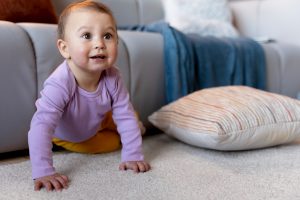
Six months is a landmark age. The baby is finding their balance and their voice at the same time.
Many babies at six months can sit with support, leaning forward on their hands to steady themselves. Some are beginning to sit briefly without any support at all. Their vision is now close to adult quality, and they are taking in the full room around them.
Babbling begins in earnest at this age. The baby strings consonant and vowel sounds together, “ba,” “da,” “ma,” repeating them in a way that has the rhythm and turn-taking quality of real conversation. They pause and wait, then vocalize again. They are learning how communication works long before they have the words for it.
They reach for objects with one hand now, deliberately and accurately. They pass objects from hand to hand. They drop things to watch them fall and look to see where they have gone. The concept of cause and effect is forming in a real and practical way.
Seven Months: A Baby Who Moves, Explores, and Chooses
Seven months is a turning point. The baby is mobile.
They roll over. They pivot. They begin to creep–crawl, which is a kind of commando crawl before the hands-and-knees crawl develops. On their back, they are equally restless, lifting the head, rolling over, squirming with energy. Stillness is becoming increasingly rare. In sitting, they still need some support, leaning forward on their hands, but they are getting there. When held standing, they bounce actively. There is joy in that movement.
Their hands are doing more complex things now. They reach for large objects, grasp them, and transfer them from one hand to the other. They rake at small objects like a raisin, though they cannot yet pick them up with precision. The hand is learning its job.
Language is emerging in polysyllabic vowel sounds, strings of sounds that have the rhythm of speech even before they carry meaning. And socially, a significant development: the baby now clearly prefers familiar caregivers. They babble. They enjoy their own reflection in a mirror. They respond to changes in the emotional tone of a conversation, not the words, but the feeling behind them.
This is emotional intelligence in its earliest form.
Eight Months: Crawling, Curiosity, and Stranger Awareness

Eight months is when many babies become truly mobile for the first time, and the house needs to be ready for it.
Many babies are crawling on hands and knees by this point or finding their own version of getting around. They pull themselves to standing when there is something to hold onto. They are determined, purposeful, and fast.
Stranger anxiety becomes pronounced at this age. A baby who was previously happy with anyone may now cry when held by someone unfamiliar, even a relative they have met before. This is completely normal and is actually a sign of healthy attachment development. It means the baby understands who is safe and who is not yet familiar.
They are also beginning to understand simple words and instructions. They may stop and look when you say “no.” They respond to their own name consistently. They point at objects with interest. The bridge between listening and understanding is being built.
Nine Months: Pointing, Playing, and Learning to Let Go
Nine months brings a baby who is communicating with great intention even without words.
They point at things they want or find interesting. This is a significant milestone: pointing is one of the earliest forms of shared attention, the baby’s way of saying “look at that with me.” It is a deeply social act and an important precursor to language.
They are now picking up small objects with increasing precision, getting closer to the pincer grasp that will arrive fully around ten months. They bang objects together. They drop things deliberately and watch where they go. They are problem-solving in a real and visible way.
Separation anxiety may peak around this age. The baby protests when a parent leaves the room because they understand that the person exists even when out of sight, and they want them back. This is object permanence applied to people, and it is a sign of cognitive and emotional development going exactly as it should.
Ten Months: Understanding, Intention, and Connection
At ten months, the baby sits alone and indefinitely, back straight, no support needed. They pull themselves to a standing position. They cruise along furniture, that sideways walking while holding on that precedes independent steps. They creep or crawl efficiently across a room.
Their hands are doing something quite sophisticated now: the pincer grasp is emerging. They use the thumb and forefinger together to pick up small objects. They poke at things with a single forefinger, that deliberate, curious, pointed exploration. They uncover a hidden toy, having understood that the object still exists even when it cannot be seen. This is object permanence, a major cognitive milestone, and it changes everything about how the baby interacts with the world.
Language has taken a clear shape: “mama” and “dada,” said repetitively, with intent. They respond to their own name. They wave bye-bye. They play peek-a-boo and pat-a-cake. The gap between baby and toddler is narrowing fast.
Eleven Months: Standing Tall and Starting to Understand
By eleven months, many babies are standing independently for short periods, even if they are not yet walking. They lower themselves carefully from standing to sitting. They are practicing balance constantly, reaching and squatting and pulling up again.
Their understanding of language is now running well ahead of their ability to speak. They follow simple instructions, “give me that,” “come here,” without needing a gesture to accompany the words. They understand “no” and often test it deliberately. They point and vocalize to communicate specific wants.
Socially, they are beginning to show a sense of humor. They repeat actions that get a laugh. They enjoy games with a predictable structure, like clap-clap or peek-a-boo, because they are beginning to anticipate what comes next. They are also becoming more aware of other children, reaching toward them and watching them with great interest.
Twelve Months: A Complete Person at the End of the First Year

At twelve months, the child who arrived as a curled, reflexive newborn is now a person with preferences, personality, and purpose.
They walk with one hand held, or independently taking a few steps. They pick up small objects with a precise, unassisted pincer movement. They say a few words beyond “mama” and “dada.” They play simple social games. They hand objects to another person on request or gesture, understanding not just language but social exchange.
They point, they wave, they clap. They show things to the people they love. They look to their caregiver’s face when they are unsure how to feel about something, a clear sign that they understand their parent as a source of safety and guidance. They will play a simple ball game, rolling or handing it back and forth. And in a small but telling sign of growing self-awareness and cooperation, they begin to make postural adjustments when being dressed, lifting an arm, shifting a leg, participating in the process rather than simply being moved through it.
They are, in every meaningful sense, becoming themselves.
Every baby follows their own timeline, but the first year remains one of the most extraordinary periods of growth and discovery. Celebrate the milestones, trust the process, and remember that your love, responsiveness, and presence are some of the most important ingredients in your child’s development.
