
Something remarkable happens in the second year of life. By the time a child reaches their second birthday, their brain has formed far more synaptic connections than it will retain in adulthood, creating a sprawling, provisional network that is actively sculpting itself through every experience, every interaction, and every ordinary moment of the day.
What shapes that architecture? More than anything else, it is the everyday.
Not structured lessons. Not expensive toys. A one-year-old’s brain grows through talking, playing, being held, going outside, hearing stories, and being responded to by the people they love. The simple moments you share with your child every day play a big role in their growth and development.
During these everyday moments, your child is also learning more than words and skills. They are discovering that they are loved, that trusted adults keep them safe, and that consistent, caring responses give them the confidence to explore and learn.
1. Talk to Them Constantly and Wait for the Answer

The single most powerful thing a caregiver can do for a toddler’s brain is to talk with them, not at them.
The Harvard Center on the Developing Child calls this “serve and return,” the back-and-forth exchange between child and caregiver that functions like a game of tennis. The toddler points at a dog. The caregiver says, “Yes! That’s a dog. A big brown dog.” The toddler says, “doh.” The caregiver responds. And so it continues. Research from Harvard’s Center on the Developing Child shows that these reciprocal exchanges directly shape the architecture of the developing brain, reinforcing the neural circuits at the core of early language, emotional well-being, and social skills.
Neuroimaging studies cited by Harvard found that children who experienced more conversational turns showed greater activation in Broca’s area, the region of the brain associated with language processing, which explained nearly half the relationship between a child’s language exposure and their verbal abilities.
In practical terms, this means narrating what you are doing during a diaper change. Asking “where did it go?” when a toy falls. Responding to babble as though it were a full sentence, because developmentally, it is. The goal is not to quiz or teach. It is to keep the conversation going.
Each warm, responsive interaction also helps your toddler feel emotionally secure. Over time, they learn that their caregivers respond with love, guidance, and comfort, helping them build trust, confidence, and a sense of safety.
2. Read Together Every Day
Reading aloud to a toddler is one of the most researched and consistently supported activities in early childhood development. In 2024, the American Academy of Pediatrics (AAP) updated its policy statement to reaffirm this, recommending that shared reading begin at birth and continue at least until school entry.
The AAP’s updated literacy policy, published in Pediatrics in September 2024, describes shared reading as a way to stimulate brain circuitry, create early attachment, and support language, social-emotional, and cognitive development simultaneously. Crucially, it is the interaction around the book, including pointing, pausing, questioning, and sharing attention, that drives the benefit, not simply hearing words read aloud.
For toddlers between one and two years, this is also a period when turning pages independently, looking at pictures, and naming objects in books begins to feel satisfying and purposeful. Reading together builds vocabulary, attention span, and a relationship to language that pays forward for years.
Choose books with large, clear images and simple text. Point to pictures and name them. Ask “what’s that?” and pause to let them respond. Let them turn the pages. The book is just the occasion. The conversation is what matters most.
This connects directly with what your child is experiencing developmentally during this period. If you would like to understand more about the language milestones your toddler is working through, our guide to your baby’s first two years walks through what to expect month by month.
3. Let Them Play, Especially Pretend Play

When a one-and-a-half-year-old presses a toy phone to their ear or gives a doll a sip of an imaginary drink, something significant is happening in their brain. Symbolic play, the ability to let one thing stand in for another, is not frivolous. It is one of the most cognitively sophisticated things a toddler can do.
The Child Mind Institute notes that pretend play has been associated with stronger executive function skills, including working memory, inhibitory control, and attentional flexibility. A five-week intervention study found that children who engaged in fantastical pretend play showed measurable improvements in working memory and attention compared to children who did not.
The AAP’s own position paper, The Power of Play, states clearly that play “enhances brain structure and function and promotes executive function” and that these gains are foundational for the ability to pursue goals and manage distractions.
For toddlers in the one-to-two-year window, pretend play begins simply: feeding a stuffed animal, pretending to cook, handing objects between imaginary participants. You do not need to direct it. Follow their lead, join in when invited, and resist the urge to correct or redirect the narrative. The more open-ended and child-led the play, the more cognitively demanding it tends to be.
4. Go Outside
A walk outside is not a break from development. It is development itself.
A 2024 review published in the International Journal of Environmental Research and Public Health found that for children under three, nature-based outdoor environments support physical, linguistic, cognitive, social, and emotional development simultaneously. The variety and unpredictability of the outdoor world, including different textures underfoot, moving objects, and changing sounds, provides a richness of sensory input that few indoor settings can replicate.
Research compiled by the Encyclopedia on Early Childhood Development further shows that regular outdoor play is linked to better attention, stronger executive functions such as working memory, and improved prosocial behavior in children.
For a toddler between one and two, simply being outside is enough. Collect leaves. Splash in a puddle. Watch a bird. Crouch down next to them and pay attention to whatever they are paying attention to. The cognitive work of categorizing, comparing, and exploring cause and effect is happening whether or not it looks like learning.
5. Sing Songs and Play with Music
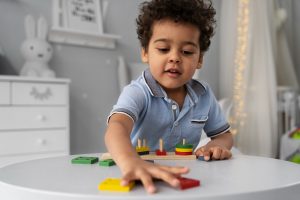
Music is one of the oldest and most natural tools in a caregiver’s repertoire, and it turns out to be one of the most effective.
Singing to and with a toddler supports language development in ways that closely mirror the serve-and-return dynamic of conversation. Songs with repetitive patterns, rhyme, and rhythm give the brain repeated exposure to the sounds and structures of language, reinforcing neural pathways associated with phonological awareness, the ability to hear and distinguish sounds, which is foundational for later reading.
Simple action songs (clapping, pointing, gesturing) add another layer: the coordination of movement with sound builds neural connections across multiple brain regions at once. Even the predictability of a familiar song provides cognitive benefit, because anticipating what comes next is itself an early form of working memory and sequencing.
Sing during diaper changes, in the car, at bath time. You don’t need to be musical. The toddler is not there to evaluate the performance.
6. Make Meals a Conversation
Mealtimes are an underrated developmental opportunity, and one that happens three times a day.
Sitting together at a table, sharing food, and talking about what you are eating gives a toddler repeated practice in language, in turn-taking, in naming things, and in the social rituals that structure daily life. For a child between one and two, meals are also a sensory experience: different textures, temperatures, colors, and smells all stimulate developing sensory pathways.
Letting toddlers feed themselves, even when it is messy, matters too. The coordination required to get food from bowl to mouth using a spoon is complex fine motor work. The mess is the learning.
Name foods. Ask questions. Respond to whatever sounds or gestures they offer. The same serve-and-return dynamic that applies to reading and play applies equally here, three times a day, every day.
7. Create Predictable Routines
A toddler’s brain does not yet have the structures to manage unpredictability with ease. Predictability does something specific and important: it reduces the background noise of uncertainty, freeing up cognitive resources for exploration and learning.
Consistent routines also help toddlers feel emotionally secure. Knowing what to expect each day teaches them that the people caring for them are reliable, helping them feel safe while they explore and learn.
Predictable daily routines, with a consistent order to waking, eating, playing, napping, and sleeping, give a toddler a framework within which the world makes sense. They begin to anticipate what comes next. That anticipation is itself an early cognitive skill.
Bedtime routines are particularly well-studied. A consistent pre-sleep sequence, such as bath, story, song, and sleep, signals to the brain that sleep is coming, which supports both sleep quality and the overnight consolidation of everything learned during the day. Sleep at this age is not passive. It is when the brain organizes and stores the experiences of the day, which is why adequate sleep in the second year of life matters so much for development overall.
A Note on Screens
The AAP’s current guidance recommends avoiding passive screen time entirely for children under 18 months (with the exception of video calling with family) and limiting use to high-quality content watched with a caregiver for children between 18 and 24 months.
The AAP notes that screen time displaces the activities that are the true building blocks of brain development: talking, back-and-forth play, singing, reading, and building predictable daily routines that help a child feel safe. This is not about screens being harmful in isolation. It is about what they replace when they become the default. You can read the current AAP screen time guidance for a full breakdown by age.
Frequently Asked Questions
Does my toddler need educational toys or programs to develop their brain?
No. The research is consistent that the quality of interaction between a caregiver and child matters far more than any toy, program, or product. A cardboard box and a parent who is present and responsive provide more developmental value than most commercial learning tools. What the brain needs at this age is stimulation, variety, and warm, responsive engagement, all of which are available in any ordinary day.
How much time should I spend doing activities with my toddler?
Even 15 to 20 minutes of genuinely focused, interactive play a few times a day has been shown to have meaningful developmental benefits. You do not need to be engaged with your toddler every waking minute. What matters is quality of interaction, not quantity of hours. Toddlers also need time for independent play and low-stimulation moments where they can consolidate what they have experienced.
My toddler seems more interested in running around than sitting for books or play. Is that normal?
Completely. Physical movement in the second year of life is itself brain development. Gross motor activity, including running, climbing, pushing, and pulling, builds spatial reasoning, body awareness, and the neural connections that underpin coordination and physical confidence. Follow your toddler’s energy rather than fighting it. Outdoor activities, chase games, and supervised climbing on safe play equipment all count.
At what age should I start paying attention if my toddler isn’t talking much?
By 12 months, most toddlers say at least one or two words beyond “mama” and “dada.” By 18 months, most have around 10 to 15 words. By 24 months, many are beginning to put two words together. That said, there is normal variation, and what matters most is the overall trajectory. A toddler who understands language, engages socially, and shows interest in communication is often developing well even if spoken vocabulary is slightly behind. If you have any concerns, your pediatrician is the right person to speak with. At 18 months, the M-CHAT questionnaire is a widely used screening tool for autism spectrum disorder that is worth discussing at your well-child visit. You can read more about developmental expectations in our guide to your baby’s first two years.
Does bilingual exposure confuse a toddler’s language development?
No. Bilingual toddlers may have smaller vocabularies in each individual language compared to monolingual peers, but their total combined vocabulary is typically equivalent. Bilingual exposure is associated with long-term cognitive advantages, and early childhood is the optimal window for natural, consistent exposure to more than one language.
How important is sleep for brain development at this age?
Profoundly important. During sleep, the brain consolidates the day’s experiences by sorting, storing, and reinforcing neural connections formed while awake. Toddlers between one and two typically need 11 to 14 hours in 24 hours, including one or two naps. A toddler who is consistently overtired has a reduced capacity for learning, memory, and emotional regulation, which is why sleep is one of the most underappreciated pillars of early brain development.
Support Your Child’s Brain Development with Expert Pediatric Guidance
The second year is a time of extraordinary cognitive construction. But none of it requires a curriculum. It requires presence, responsiveness, and the willingness to follow a small person’s curiosity wherever it leads. The most powerful thing you can offer is not a program or a product. It is you: paying attention, talking back, and showing up for the unremarkable moments that turn out to be anything but.
If you have questions about your child’s development or would like reassurance about their progress, schedule a consultation with Dr. Sabitha Nair in Dubai. She provides thorough, personalized pediatric assessments and guidance to support your child’s healthy development.
