
Every parent knows the scene. A bowl of carefully prepared food. A child who clamps their mouth shut, turns their head away, or dissolves into tears at the sight of a spoon. Mealtimes start to feel like a battle, and somewhere along the way, eating – the most basic of things – becomes a source of daily stress.
The good news is that most picky eating is not something children are born with. It is something that quietly develops over time, often because of small habits established in the first year of life. The even better news is that it is largely preventable, and the window to get it right is already open from the moment your baby turns six months old.
This is not about rigid rules or nutritional perfection. It is about understanding how a child’s relationship with food is built and what parents can do from the very beginning to make sure that relationship is a healthy one. Discuss any specific feeding concerns or questions with your pediatrician, who can guide you based on your child’s individual growth and development.
Start Early – Much Earlier Than You Think
The single most important thing parents can do is start right at six months, which is when solid foods are introduced. This is not just about nutrition. It is about building a habit, a rhythm, and a familiarity with food that will carry through childhood.
At six months, most babies are already showing a key developmental milestone: they are picking up objects and bringing them to their mouth. That hand-to-mouth movement is not random. It is part of how babies explore and learn. The moment you notice your baby doing this, that is your cue to introduce a spoon.
Here is how to do it well:
- Give your baby their own bowl and spoon while you feed them.
- Let the baby attempt to bring food to their mouth themselves, even if it is messy.
- The parent feeds simultaneously, assisting and guiding, while the baby experiments.
- This dual feeding approach teaches self-feeding early and builds the child’s comfort and confidence with food.
It sounds simple, but this one practice does something important. The child is an active participant in eating from the very beginning, not just a passive recipient of a spoon being pushed into their mouth.
The Texture Timeline: Why Blending Is Not the Answer

One of the most common mistakes parents make is keeping food too smooth for too long. Texture matters. A child needs to learn how to handle food in their mouth, and that learning only happens with exposure.
Here is the progression that works:
6 to 6.5 months
Start with slightly mashed food. For the first two weeks, food can be blended, but move away from this quickly. After that, mash food with your fingers or a spoon. Dal, rice, soft-cooked vegetables. The food should have small particles in it. Never blend in a machine past this early stage.
8 months
Introduce large solid pieces. This surprises most parents, but bigger pieces are actually safer because the child has better control over them. A piece of banana, a soft idli broken into four pieces – these are ideal. The child can hold them, gum them, and manage them at their own pace. Small pieces are more likely to cause choking.
12 months
By the time your child turns one, they should be eating everything the family eats, in approximately half the quantity. There should be no separate pot of special food being made for the baby. This is what is called family pot sharing, and it is a cornerstone of raising a child who eats without drama.
The Flavour Window: Do Not Miss It

Between six months and one year, your baby’s brain is actively learning what food is supposed to taste like. This is the flavor window, and it is the most important period in your child’s entire food education.
Feeding completely bland food throughout this window teaches the child that food is flavorless. And that is a habit that is genuinely difficult to undo later.
For an Indian household, this matters enormously. Your child will grow up eating dal, rice, sambar, sabzi, and everything that comes with the flavors and aromas of home cooking. The goal is not to shield them from those tastes – it is to introduce them gently and early.
After eight or nine months, you do not need to make separate food. Simply take a bowl of plain rice or dal and add a small spoon of whatever you are cooking, such as sambar, a mild sabzi, a little rasam. The child gets the flavor without the full intensity of salt and spice.
Introduce everything:
- Bitter vegetables like karela
- Sour tastes
- Mild spice from regular home cooking
Children who are introduced to a wide range of flavors in the first year are far more likely to accept those foods later in childhood.
Foods to avoid until one year: Salt, sugar, honey, and fresh cow’s milk. These are the four to keep off the table entirely. Everything else can come in, diluted and low-spice, within reason.
The Role Model Effect: Eat Together, Always
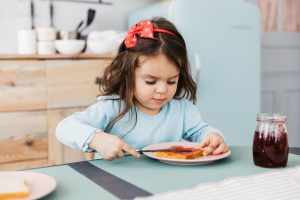
Children learn by watching. A child who sees adults eating vegetables, eating variety, and eating with enjoyment is far more likely to do the same. A child who is sat separately with a special plate of “child food” gets a very different message.
Eat together as a family whenever possible. Let your baby sit at the table with everyone. Allow them to observe, reach for food, and be part of the social experience of eating. This is not just about nutrition. It is about the culture of food in your home.
And one important instruction: avoid force feeding. Forcing a child to eat does not teach them to like food. It teaches them that mealtimes are stressful, that eating is a struggle, and that the table is not a safe place. That association is difficult to reverse.
What to Do When Your Child Refuses a Food
Rejection is normal. A child refusing a new food is not a sign that they will never eat it. It is simply a response to novelty, which is developmentally expected.
The approach that works:
- Offer the refused food over 15 consecutive days, for about 15 minutes at a time.
- If after consistent, patient offering the child still refuses, let it go for now.
- Come back to that food weeks or months later – children’s preferences shift.
- One refusal, or even ten refusals, does not mean a lifetime of avoidance.
The pattern most parents fall into is offering a food two or three times, deciding the child “does not like it,” and removing it from the menu permanently. This is how picky eating takes hold.
Structure Mealtimes – And Stick to It
This is one of the most practical and impactful things you can do. Mealtimes should have a defined start and end.
- Thirty minutes maximum per meal, wherever possible.
- Fix the time: for example, breakfast from 9.00 to 9.30.
- Whatever the child eats in that window is fine — then mealtime ends.
- The child is given the freedom to go, even if they have not finished.
- Between meals, only plain water – no snacks, no milk, no juice.
This structure does something powerful. The child learns that hunger is a signal that leads to a mealtime, and that mealtime is finite. A child who is allowed to graze all morning – a biscuit at 9, a bit of fruit at 10, milk at 11 – arrives at lunch with no real hunger and no real interest in eating. And then parents wonder why the child will not eat at the table.
Hunger is the best appetite. As simple as it sounds, food always tastes best when a child is genuinely hungry. Build that hunger in. Let the child feel it. Then watch them eat.
A Quick Summary for Parents
- Start spoon feeding and self-feeding practice at six months.
- Move from blended to mashed to solid food progressively, texture matters.
- Introduce flavours from home cooking between eight and twelve months.
- No salt, sugar, honey, or fresh cow’s milk before one year.
- Family pot sharing by twelve months, no separate child food.
- Eat together so children learn by observation.
- Never force feed.
- Offer refused foods patiently over 15 days before letting go.
- Keep mealtimes to 30 minutes with a fixed time.
- No snacking between meals, water only.
Most picky eating is not inevitable. It is the result of habits that formed quietly in the first year. The good news is that you have everything you need, right now, to build those habits well.
Frequently Asked Questions
At what age should I start introducing solid foods and self-feeding to my baby?
Solid foods are introduced at six months, and this is also the right time to begin encouraging self-feeding. Give your baby their own bowl and spoon alongside their regular feed. Babies at this age are already exploring hand-to-mouth movements as part of their development, which makes it a natural time to build familiarity with food and utensils. Starting early with this dual approach, where the baby tries to feed themself while a parent assists, builds independence and reduces fussiness around food later on.
Why is my one-year-old so fussy about food, and how do I handle food refusal?
Food refusal in toddlers is common and often traces back to limited flavor exposure in the first year or to patterns like force feeding and constant snacking that interfere with natural hunger. When a child refuses a food, offer it consistently over 15 days for short periods before deciding to move on. Ensure mealtimes are structured to 30 minutes, with no snacking between meals, so the child arrives at the table genuinely hungry. Eating together as a family also makes a significant difference. Children learn to accept a wider range of food by watching the adults around them eat it. If fussiness is severe or affecting your child’s growth, speak with your pediatrician.
Is it safe to add spices and flavors to baby food before one year?
Yes, with some care. After eight to nine months, you can begin adding small amounts of home-cooked flavored food, like a spoon of sambar or a little dal tadka, into a bowl of plain rice or mashed food. The goal is flavor exposure, not intensity. This is important because the window between six and twelve months is when babies form their baseline sense of what food tastes like. Keeping food completely bland throughout this period can lead to strong food preferences and fussiness later. The foods to avoid entirely before one year are salt, sugar, honey, and fresh cow’s milk. Everything else, diluted and low-spice, can be introduced gradually.